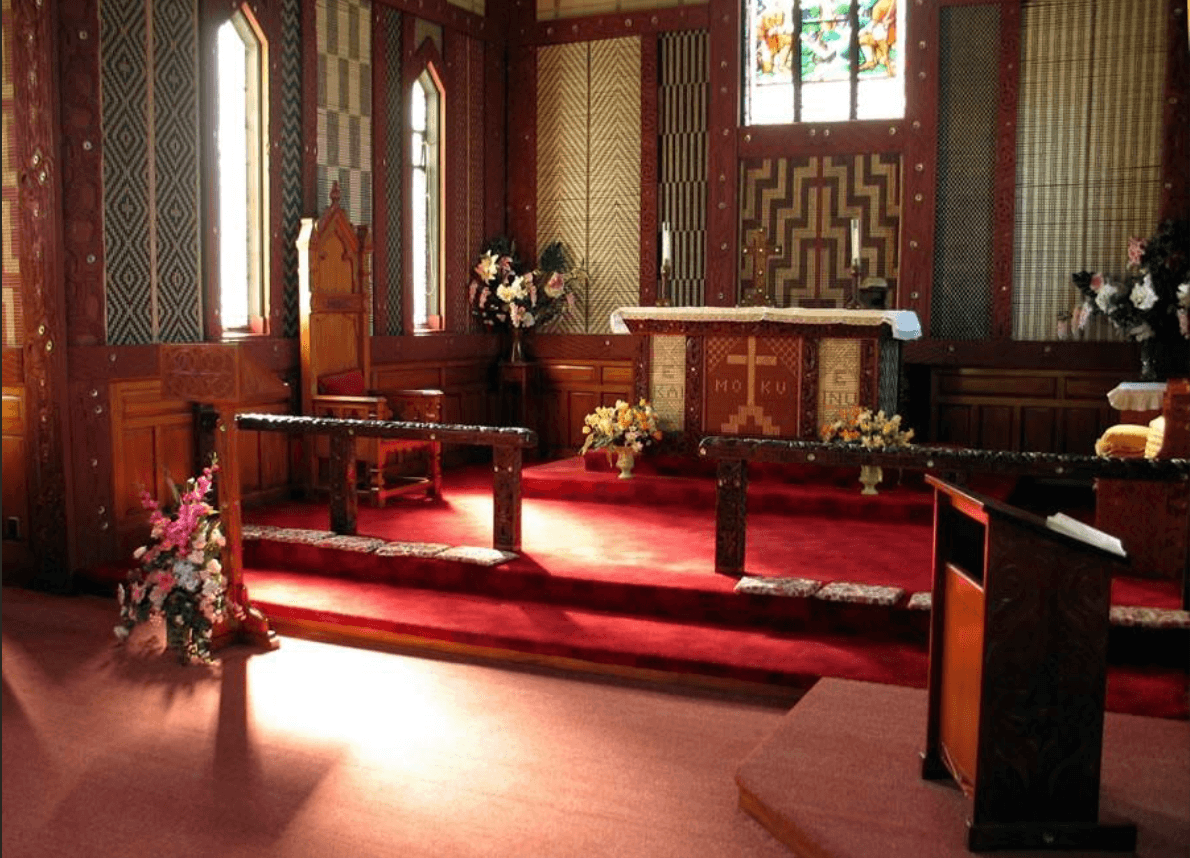
The carved altar in St Mary’s Memorial Church, Tikitiki. File/NZHistory.govt.nz
On 16 February 1926, around 5000 people gathered at Rāhui Marae in Tikitiki for the opening of the Tikitiki Memorial Church — St Mary’s. Among them were the Governor General Sir Charles Fergusson, Prime Minister Gordon Coates, and Bishop William Sedgwick.
Ahead of the centenary of the iconic church, let’s take a look down memory lane of how newspapers of the time offer a vivid snapshot of Church–public relations and Māori–Pākehā dynamics during the event.
The day before the opening, the Poverty Bay Herald tracked Prime Minister Coates’s movements and emphasised the scale of the gathering:
“Not only will the hui be officially chronicled, but many photographs and cinematograph films also will be obtained… two photographers left Gisborne for Tikitiki this morning.” — Poverty Bay Herald
Vision captured by the NZ Film Unit can be found here. It includes footage of the pōhiri, in which Sir Apirana Ngata leads the Ngāti Porou men in haka and snippets of the old church building, Kahukura, which stood in the grounds of Rāhui Marae, across the road from the current St Mary’s Church
A few days earlier, a columnist struck a different tone, framing the church as evidence of Māori “progress” under missionary influence:
“It is a unique testimony to the raised standard of the living Māori mind and character, built upon the efforts of the early missionaries…
“It is a transformation, which many in this locality have witnessed, of a people living under barbarous conditions, becoming obedient to civilised law and order, and, in our schools and universities, taking an equal place with Europeans.” — Poverty Bay Herald
In covering the opening of St Mary’s, the same paper then published a detailed account of Taumata-a-Kura and his role in spreading Te Rongo Pai across the eastern seaboard. It included a description of the carved font dedicated to him:
“…the pedestal of which is in the form of a man’s torso… The figure is that of Taumata-a-Kura.”
“Taumata-a-Kura forthwith set out to preach the Gospel… before the missionaries.
“The story of Taumata-a-Kura, would not be completed if mention were not made of the spread of the religion he preached, through the territories to the southward. The warriors of Poverty Bay, Hawke’s Bay, and the Wairarapa, who had been engaged with the Ngāti Porou in the Bay of Plenty enterprise, carried back with them reports of the Christ who was new to them, and so were sown the seeds of the pākehā religion throughout the southern portion on the island.” — Poverty Bay Herald
Another article in the same edition focused on the craftsmanship of St Mary’s, especially the care taken to reproduce traditional patterns:
“Those responsible… have erected a monument of their own enthusiasm… which must compare favourably with anything of its kind in the Dominion.” — Poverty Bay Herald
On the day of the opening, a Press Association report was syndicated nationwide, from Otago to Northland:
“Poi dances were followed by hakas [sic], one led by the Hon. A. T. Ngata depicting the stages of the Great War…” — Press Association
Another Press Association article, dated two days following the opening, quoted Prime Minister Coates in returning thanks suggested the significant day should be an illustration to Pākehā “what they owed to Māori” while also serving to strengthen the bonds between the two peoples.
““You only have to look on the hill,” said the Premier, “and remember that when the Empire was in trouble, New Zealanders offered their services as men, Māori and Pākehā, and as Māori and Pākehā they fell side by side.”” — Press Association
In June 1926, Toa Takitini published comments from the visitors’ book, capturing Māori and Pākehā reactions to the new church:
- Te Rangi Hīroa (Sir Peter Buck): Ko te hononga o te ao tawhito ki te ao hōu
- Tā Timi Kara: “Far exceeds ordinary conception”
- Tiemi Mete (Nūhaka): He whakamaharatanga e whakapehapeha ai te ngākau
- Wm. Cooper (Gisborne): Māwai e whakataetae?
- F. A. Bennett: “Uira ana tō whare, e Ngāti Porou.”
- Ruiha Hakiwai (Ōmāhu): He tohu nui nō te whakapono
- Wiremu Takana (Dannevirke): Ko te hui tino pai tēnei o ngā hui katoa i tae ai ahau…