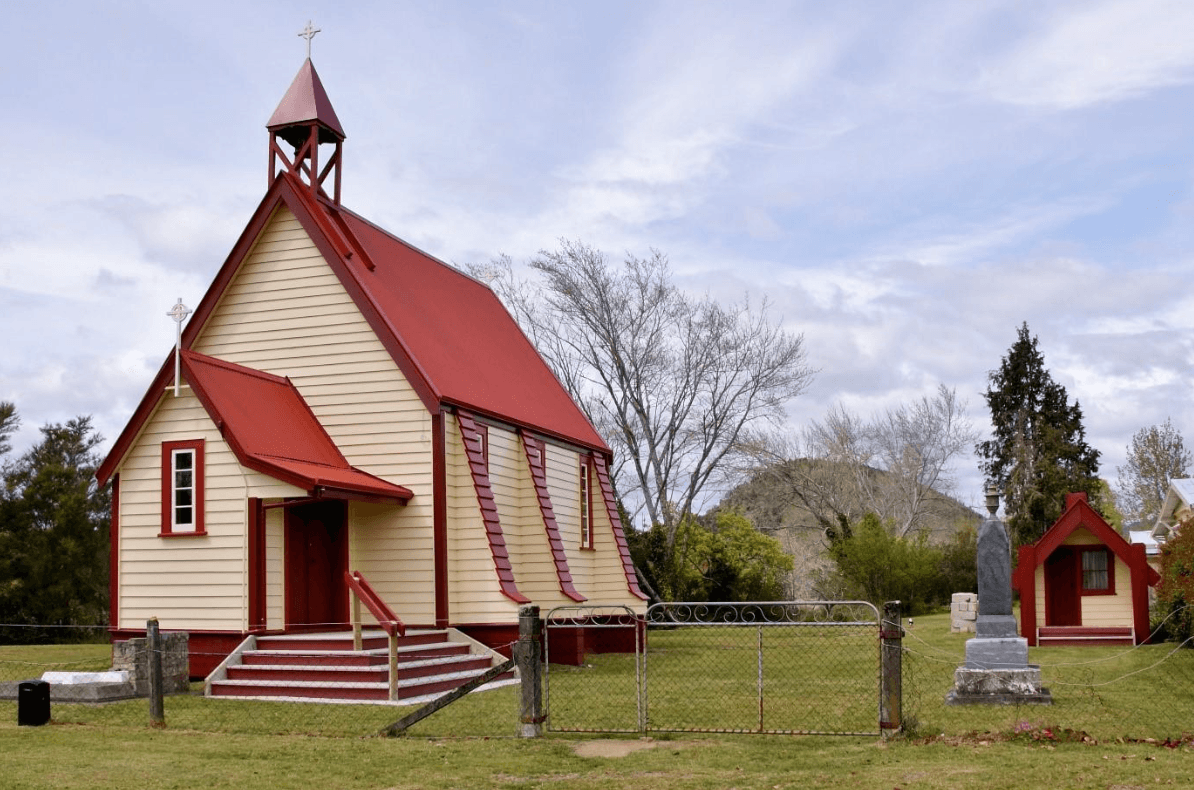
St Pauls Church, Tokaanu. By Shellie Evans. CC BY-SA 3.0, https://commons.wikimedia.org/w/index.php?curid=20043901
“A tēnei ake, i te wāhi i kīia ai ki a rātou, ‘Ehara koutou i te iwi nōku,’ ka kīia anō rātou he tamariki nā te Atua ora.” – Rōmana 9:26
“In the very place where it was said to them, ‘You are not my people,’ there they will be called ‘children of the living God.’” – Romans 9:26
Today te Hāhi Mihinare in Aotearoa commemorates Te Mānihera and Kereopa, remembered as the first Mihinare martyrs in this land. Their story is one of mission, tragedy, reconciliation, and hope — with the transforming power of God at its centre.
Early Life and Formation
Te Mānihera (Ngāti Ruanui), born Poutama, grew up amid the turbulence of early 19th century conflict. Taken captive first by Waikato and later by Ngāpuhi, he spent time with missionaries in Tonga and at the CMS station on Norfolk Island, where he learned to read and write.
By the 1840s he had returned to South Taranaki, becoming an Anglican teacher at the Waokena CMS station near Hāwera. He received the baptismal name Mānihera in honour of the missionary Robert Maunsell.
A Call to Mission
At a Christmas Eve service at Pūtikiwharanui in 1846, led by Rev. Richard Taylor, Te Mānihera spoke of his conviction that Māori who had received the Gospel should now carry it to their own people.
This calling came at a time of unresolved conflict between Ngāti Ruanui and Ngāti Tūwharetoa, including the unavenged deaths of two Tūwharetoa men in 1840. Despite warnings about entering hostile territory, Te Mānihera resolved to travel to Taupō to preach a message of peace. Kereopa, a fellow teacher from Waokena, volunteered to accompany him.
The Journey and the Ambush
On 6 February 1847, the pair set out from South Taranaki, travelling through Manawatū and Rotorua before entering Tūwharetoa territory. After meeting with Iwikau Te Heuheu Tūkino II, they continued south. On 12 March, near Tokaanu, they were ambushed by a party led by the elderly chief Te Huiatahi.
Kereopa was killed instantly. Te Mānihera died several hours later from his wounds.
Reconciliation and Legacy
What followed became a landmark moment in intertribal reconciliation. Rather than seeking utu, Ngāti Ruanui asked Rev. Taylor to mediate. Taylor met with the Tokaanu chief Te Herekiekie, who acknowledged the killings as customary retribution and invited Ngāti Ruanui to visit his pā in peace.
The image depicts a solemn scene with a preacher, likely Reverend R. Taylor, addressing a gathering of people near a grave, possibly in the context of a funeral or memorial service.
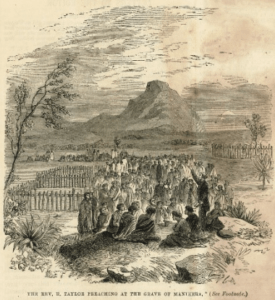
Rev. R. Taylor preaching at the grave of Mānihera Poutama. Image/CMS Archives
In 1849 a delegation from Ngāti Ruanui accepted the invitation. At the graves of the missionaries, Te Huiatahi offered to build a church and asked for a missionary to live among his people.
The church was built at Poutū near Tokaanu, and Piripi Hanataua — Te Mānihera’s successor at Waokena — remained to serve there, a living sign of forgiveness and the Gospel’s power to turn enemies into whanaunga.
Today, Te Mānihera and Kereopa are honoured with a memorial at the entrance to St Paul’s Church, Tokaanu, where their descendants continue to return to remember their tūpuna.