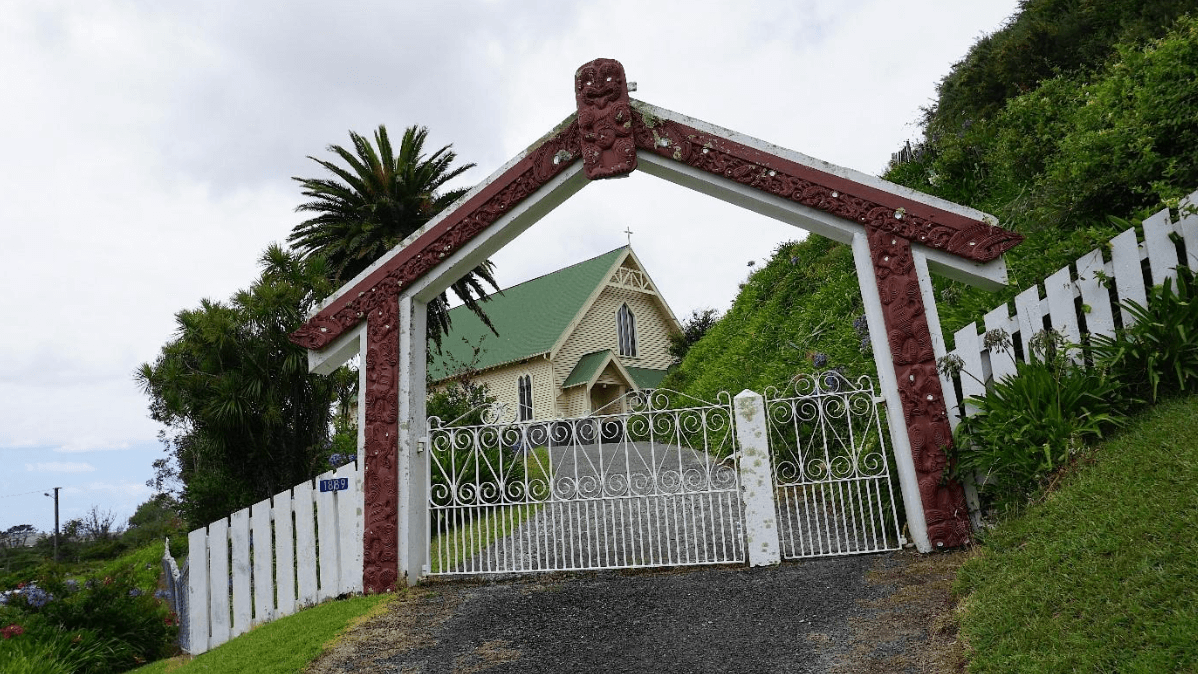
Entrance to St. Mary's Church in Tikitiki. Photo/Kristina D.C. Hoeppner
The Church of St Mary, Tikitiki, standing proudly on the brow of Pukemaire—a hill long associated with the defence, identity, and mana of the hapū of the Waiapu Valley—will celebrate its centenary next month.
On 16 February 1926, more than 5,000 people are reported to have descended on the Waiapu Valley, with at least 2,000 camping under marquees across the road at Rāhui Marae. It was an occasion of immense pride for the people of Waiapu and for Ngāti Porou as a whole. Media at the time even suggested it might be the “last great gathering of the native race,” a reflection of the era’s colonial assumptions rather than the enduring vitality of Ngāti Porou.
Such was the significance of the event that Their Excellencies the Governor-General, Sir Charles and Lady Fergusson, Prime Minister Gordon Coates and Mrs Coates, Sir Peter Buck, and Sir Māui and Lady Mira Pōmare all made the long and arduous journey to Tikitiki.
Instigated by Sir Apirana Ngata in honour and memory of the Ngāti Porou men who served in World War I, the foundation stone was laid on ANZAC Day 1924. True to form, Tā Apirana designed St Mary’s to present as a typical Christian church from the outside, while its interior was richly adorned with traditional Māori art.
The church features spectacular carvings on the pews, door surrounds, altar rail, and pulpit—the latter two gifted by Waikato and Te Arawa iwi respectively. The baptismal font is a carved depiction of Taumataakura, the Ngāti Porou rangatira credited with spreading Te Rongo Pai—the Glad Tidings of the Gospel—throughout Te Tairāwhiti. Its unveiling in 1926 enabled local and national media to share Taumataakura’s story, challenging the longheld assumption that Pākehā missionaries alone had planted the seeds of Christianity some 90 years earlier.
Sir Apirana Ngata was deeply committed to reviving Māori artistic expression—whakairo, kōwhaiwhai, tukutuku—and saw Māori churches as vital spaces for this renaissance. Hone Ngatoto, a local master carver, oversaw much of the work. Among his students was Pineamine Taiapa who, alongside his younger brother Hone, would later become central figures in the national revival of whakairo.
The stained-glass window behind the altar is both impressive and deeply moving. A visual reminder of the sacrifices made by Ngāti Porou men, women, and whānau during the Great War of 1914–1918. At its centre is a depiction of the crucifixion of Jesus Christ, with two Māori soldiers—Lt. Henare Kōhere and Cpt. Pekama Kaa—kneeling at his feet.
Lt. Kōhere, grandson of the Ngāti Porou chief and laypreacher Mōkena Kōhere who built the first church at Rangitukia, died of wounds sustained at the Somme. On his deathbed, he nominated his cousin Cpt. Kaa to replace him as commander of his platoon. Pekama Kaa, whose whānau has contributed no fewer than 15 clergy to the hāhi across generations, was himself killed a year later.
Fittingly, Lt. Kōhere’s daughter, Te Huinga, also a mokopuna of Rev. Mohi Tūrei, had the honour of being the first to be married in the new St Mary’s when she wed All Black George Nepia on 6 May 1926.
In 2002, Ngāti Porou and the New Zealand Historic Places Trust collaborated to conserve the church’s interior artworks. St Mary’s is now registered with Heritage New Zealand as a Category 1 Historic Place.
Colloquially known as the Cathedral of Ngāti Porou, St Mary’s continues to hold deep significance for its people. It stands on Pukemaire not only as an architectural treasure, but as a living symbol of faith, identity, and the enduring spirit of Ngāti Porou.