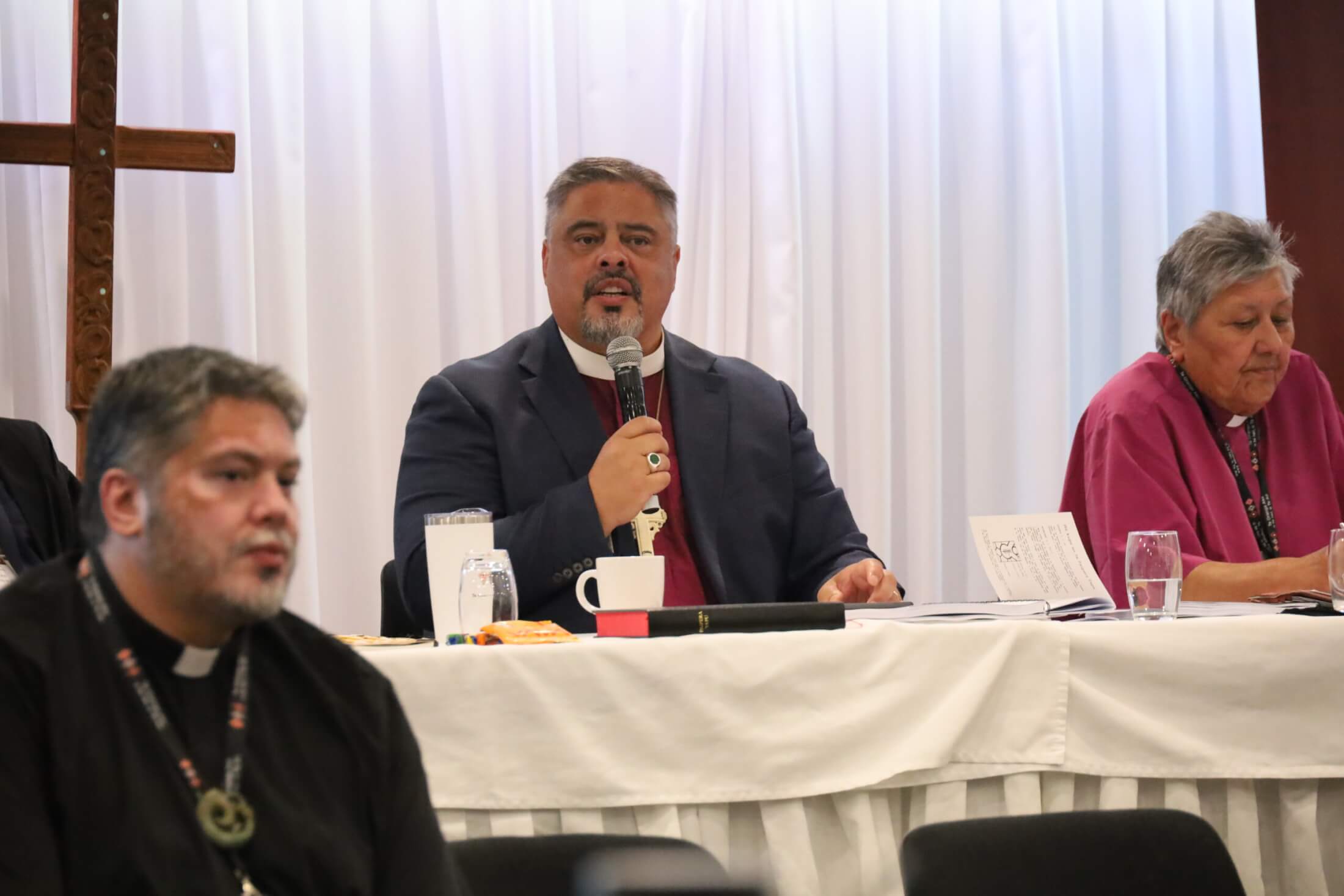
The Most Reverend Dr Don Tamihere is calling for distributive justice and equity for Tikanga Māori within the Anglican Church and says the distribution of funding from St John’s College Trust Board is the natural first step.
In a working paper titled “Ma Wai Ra e Taurima?“(Who will bring balance and restore peace?), Archbishop Don argues equity is a moral and interventionary action, essential for rectifying historical disadvantages.
That paper was presented to the 23rd session of Te Rūnganui in New Plymouth with the delegates unanimously accepting it and offering ongoing support to pursuit its intentions.
Archbishop Don, in the paper revisits “Motion 27”, passed unanimously at the 2012 General Synod/te Hīnota Whānui, which sought to give Tikanga Māori expression of tino rangatiratanga on 50% of the SJCTB’s assets.
“Motion 27 was intended to affirm Tino Rangatiratanga for Tikanga Maori at the level of the SJCTB itself, and more particularly over 50% of the SJCTB’s asset, funding allocation, and distribution.
“The aspirations of Motion 27 remain in our view a necessary intervention, consistent with our understanding of equity as biblical justice and Tino Rangatiratanga.”
The paper frames equity within both biblical justice, which calls for the liberation of the poor and oppressed, and Tino Rangatiratanga, the Māori right to self-determination as guaranteed by Te Tiriti o Waitangi. The Anglican Church is held as the “Church of The Treaty” due to its heavy influence in the drafting of and delivery of that sacred covenant.
In the Gospel of Luke, Jesus announced his ministry by reading the scroll of Isaiah. Archbishop Don interprets that as Jesus focusing on doing justice for the poor and oppressed.
“Further, Jesus’ use of this passage from Isaiah evokes the precepts of Jubilee found in Leviticus 25ff, which have to do with the elimination of financial debt and the return of ancestral land to ancestral owners.
“That is to say, Jesus is interested in a justice that restores equity to those who have been disadvantaged,” Archbishop Don says.
A general survey taken in June 2025 revealed the combined annual income of Tikanga Pākehā dioceses was approximately $424 million, while Tikanga Māori received about $19 million.
He argues that without a proper understanding and application of equity in the allocation and distribution of Church funding and resources, the Tino Rangatiratanga of Tikanga Māori will remain frustrated, undermined and marginalised.
“Whether intentional or not, settler colonialism has delivered our Pākehā church structure a significant historical advantage with regard to resource and capacity. Conversely, our Māori church structure has been dealt an almost unassailable disadvantage.”
Noting his predecessor, Archbishop Brown Tūrei at the 2014 GSTHW, he highlights the significant contribution Māori have made to the establishment of the Anglican Church in Aotearoa, particularly the gifting of land, materials, funds and labour.
“Such was their belief in the promise of the Gospel: “I bring you glad tidings of great joy,” Archbishop Brown said at the time, invoking the words of Rev. Samuel Marsden at the first Christian service held on this whenua in 1814.
Archbishop Don is urging the implementation of Motion 27’s aspirations and the prioritisation of Tikanga Māori and Tikanga Polynesia for SJCTB funding to achieve distributive justice.
“We do not begrudge the flourishing of Tikanga Pākehā but ask only that Tikanga Māori be allowed to flourish as well,” he added.
The paper concludes by reiterating the SJCTB is one of the few avenues through which Tikanga Māori can seek the justice and equity required to flourish and overcome the historic disadvantages it continues to face withing the Three Tikanga Church.
n.b. The title Mā Wai Rā e Taurima? is derived from the waiata I runga ahau o Ngāpuhi by Henare Te Owai, a lament for the late Rev. Pine Tamahori and calls for “tika” (justice), “pono” (integrity), and “aroha” (compassion) to guide the way forward.