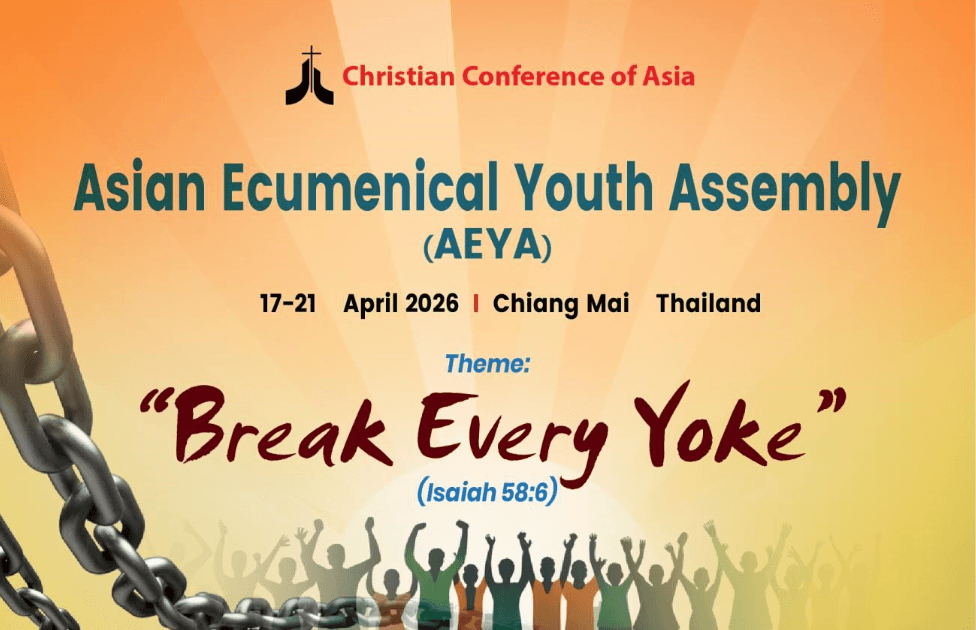
Christian youth representatives from across Asia and neighbouring regions will gather in Chiang Mai, Thailand, this week for the 5th Asian Ecumenical Youth Assembly (AEYA).
Kauri Tangohau is one of the representatives from Te Pīhopatanga o Aotearoa, joining an Aotearoa New Zealand delegation attending the five-day conference.
“Our role is to carry the voice and perspective of our people into this space — shaped by whakapapa, faith, and our tikanga values such as whanaungatanga and manaakitanga. We are heading to Chiang Mai to listen deeply, contribute authentically, and engage in conversations around justice, faith, and Indigenous realities.”
AEYA brings together young Christian leaders from across the region to confront the pressures shaping their generation, offering space to build relationships, share knowledge, and wānanga across cultural and national contexts.
“While our contexts differ, many of us are grappling with similar challenges affecting rangatahi. Hearing how other young people and Indigenous communities’ express faith, respond to justice issues, and build resilience helps deepen our understanding and challenges our own practice. In turn, we bring our Māori worldview, our experience as a three Tikanga church, and our ongoing journey of Treaty-based partnership.”
AEYA is the Christian Conference of Asia’s (CCA) flagship youth gathering. Established in the 1960s, it has a strong tradition of cultivating ecumenical, justice-focused Christian leadership across Asia.
This year’s theme, Break Every Yoke, draws inspiration from Isaiah 58:6, calling for the active freeing of the oppressed and the breaking of unjust bonds — the metaphorical ‘yokes’ placed upon people.
Organisers say these ‘yokes’ are evident across the region, with conflict, violence, militarisation, and repressive state structures leaving young people particularly vulnerable.
“The theme speaks to liberation — spiritually, socially, and structurally. It’s about recognising and confronting the systems and burdens that continue to oppress our people.”
Kauri says the shared experiences of Indigenous peoples, particularly the impacts of colonisation, are an important contribution the Māori delegation brings to the gathering.
“It’s not only about naming these ‘yokes’, but actively working to dismantle them. From a Māori perspective, this aligns with our journey of decolonisation, healing, and the restoration of mana. It calls us to uphold dignity, protect our tikanga and reo, and pursue Oranga Ake — living a life grounded in aroha, seeking to fulfil hari, and living in relationship with God, our taiao, and our people.”
Around 150 rangatahi, aged 20–35 years, are expected to attend the conference, which includes workshops, Bible studies, and church visits.
The complete provincial delegation is Alokoulu Ulukivaiola, Daniel MacDonald, Hannah Corbett, Kate Tarere, Kauri Tangohau, Loini Simeti, Shinaya Kaiwai (all ACANZP), Elizabeth Salesa (Methodist Church of NZ) Te Amorangi Dixon-Te Ahu (Methodist Church of NZ).