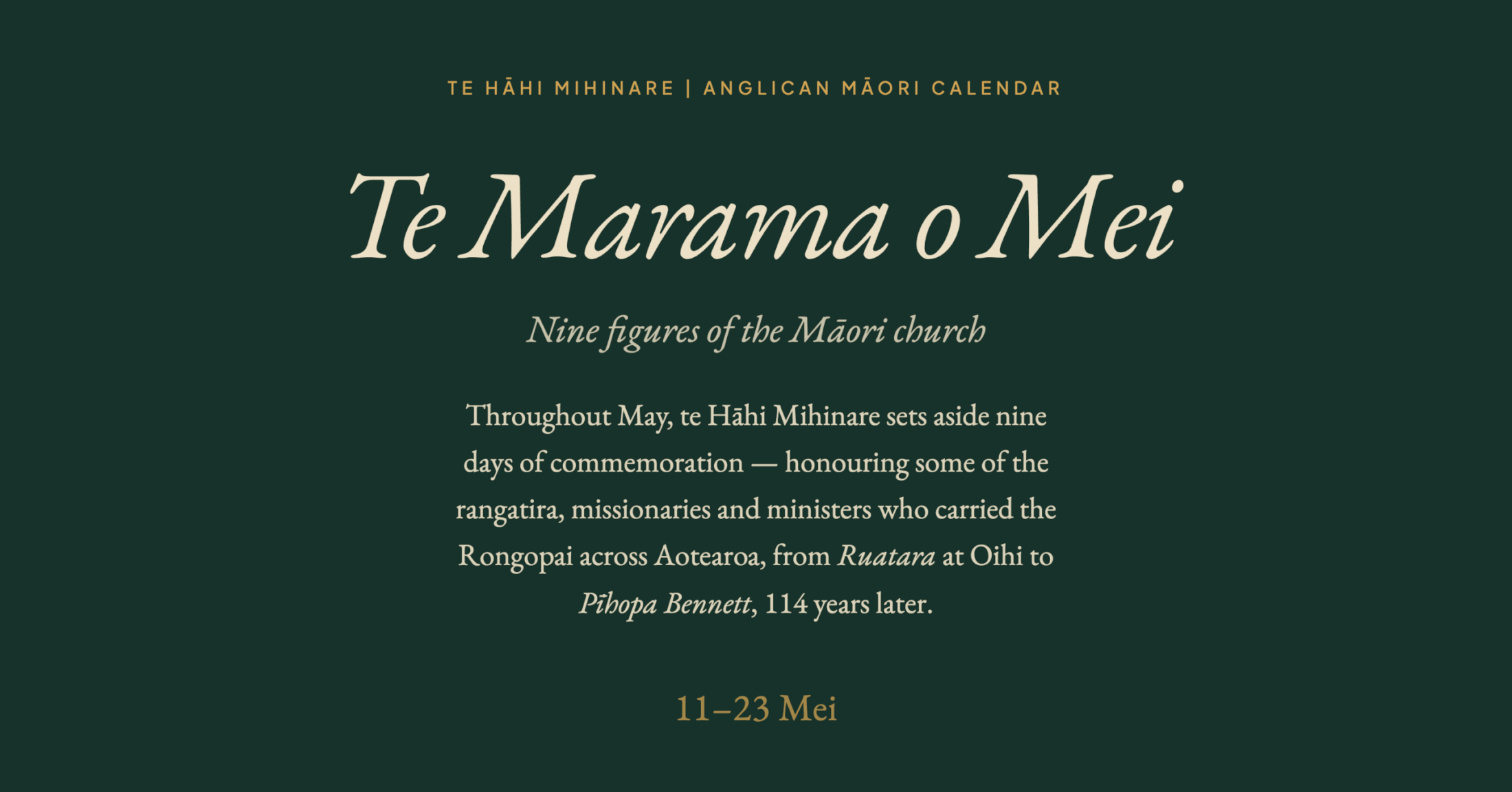
In the Anglican Calendar in Aotearoa, the month of May is
a significant month for Te Hāhi Mihinare, particularly for Māori.
A total of nine days are set aside to commemorate prominent Māori figures of the early history of the Church. The following are brief exerpts of their stories, taken from For All the Saints.
Ruatara – May 11
Ruatara, a chief of the Ngā Puhi people, became friendly with Marsden in Australia. Ruatara made possible the voyage which culminated in the first official Christian service in New Zealand at Oihi Bay in the Bay of Islands on Christmas Day 1814. Ruatara hoped that the mission would bring technological and other resources for the community to develop. Marsden hoped that Ruatara’s hospitality and protection would pave the way for the seeding of a Christian mission. Ruatara became known as “Te Ara mō te Rongopai”, “The Gateway for the Gospel”.
E mahara ngā pito katoa o te whenua, ā, ka tahuri ki a Ihowā; ka koropiko anō ngā hapū katoa o ngā iwi ki tōu aroaro. Waiata 22:27
Let all the ends of the earth remember and turn to you, O Lord; and let all the families
of the nations bow down before you. Psalm 22:27
Ihaia Te Ahu – May 13
Ihāia Te Ahu of Ngāpuhi was one of the earliest of the Māori clergy. He joined Thomas Chapman of the Church Missionary Society in the Bay of Islands as a small boy and later went with Chapman to Rotorua and then to Maketū in the Bay of Plenty. On Chapman’s retirement in 1861 Ihāia was ordained, serving first in Maketū and then in 1882 becoming the first vicar of the Ōhinemutu pastorate. Ihāia’s godly, patient ministry in complex and challenging circumstances eventually became very influential. He died in 1895.
Ā, e ruia ana ngā hua o te tika i roto i te rangimārie mā te hunga hohou rongo. Hēmi 3:18
A harvest of righteousness is sown in peace for those who make peace. James 3:18
Ngākuku – May 14
Ngākuku was a Ngāti Haua chief of the Waikato. His links with the gospel began with the missionary education of his daughter Tarore at Matamata. He was baptised on Good Friday 1839. He accompanied Archdeacon A.N. Brown on some missionary journeys and also became a missionary in his own right in the Bay of Plenty, Urewera, and East Coast areas. He was involved in pioneer work in the Ōpōtiki area. After the tragic death of his daughter in a raid in 1836, he was able to forgive those who took her life and encouraged others to do likewise.
Kia houhia ai anō hoki e ia te rongo a te tokorua ki Te Atua i roto i te tinana kotahi, he meatanga nā te rīpeka, mā reira hoki e whakamate te mauāhara. Epeha 2:16 (whakarite)
Christ reconciled both Gentiles and Jews to God in one body through the cross, thus putting to death the hostility through it. Ephesians 2:16 (adapted)
Taumata-a-Kura – May 15
Piripi Taumata-ā-kura of Ngāti Porou was responsible for introducing the gospel to his people in the East Cape area in the early 1830s. He had been influenced by the gospel in the north, and on his return had taught and preached, using short prayers and hymns, referring to Bible texts written on scraps of paper. He successfully negotiated restraint based on Christian principles in an inter-tribal battle in 1836. He gained great mana among his people and eventually made the way possible for a missionary training team of nine young Māori from Paihia to carry on his work.
Tēnei te ungā atu nei e ahau tāku karere, māna e whakapai te ara i mua i ahau, e ai te Ihowā. Maraki 3:1
See, I am sending my messenger to prepare the way before me, says the Lord of hosts. Malachi 3:1
Te Wera Hauraki – May 16
Te Wera was a Ngāpuhi chief from the north who settled at Māhia on the East Coast, creating peace with his former enemies there and providing a mantle of protection and solidarity throughout a large part of Ngāti Kahungunu. Because of the peace and order he introduced, hospitality towards missionaries became possible. By the time of his death in 1839 an indigenous Māori Christian mission was growing within the kinship networks of the area.
Whakawhirinaki ki a ia i ngā wā katoa, e te iwi, ringihia tō koutou ngākau ki tōna aroaro; hei piringa mō tātou te Atua. Waiata 62: 8
Put your trust in God always, you people; pour out your hearts before the one who is our refuge. Psalm 62:8
Wiremu Te Tauri – May 17
Wiremu Te Tauri of Ngāti Tūwharetoa and Whanganui was for some time the head teacher for Richard Taylor. He was present at the tangi for the martyrs Te Manihera and Kereopa in 1847 and argued against utu. He said, “A minister was like a lofty kahikatea tree full of fruit, which it sheds on every side around, causing a thick grove of young trees to spring up; so that although the parent tree may be cut down, its place is thus more than supplied by those which proceed from it.”
Ka kōpatapata iho tāku whakaako, ānō he ua, ka māturuturu iho tāku kupu me te tōmairangi; me te ua pūnehunehu ki runga i te tupu hou, me te ua tā ki runga i te tarutaru. Tiuteronomi 32: 2 May my teaching drop like the rain, my speech condense like the dew, like gentle rain on grass, like showers on new growth. Deuteronomy 32:2
Tāmihana Te Rauparaha – May 18
Tāmihana Te Rauparaha, the son of the great Ngāti Toa chief, Te Rauparaha, and Mātene Te Whiwhi, another young chief of Ngāti Toa, were influenced by reading the Gospel of Luke, and went to the Bay of Islands to request a missionary for the area at Ōtaki. This led to the appointment of Octavius Hadfield. The mission became highly successful. Tāmihana is also widely remembered for his courage and imagination in travelling to many of the places ravaged by his father in the South Island, preaching reconciliation and the gospel of peace.
Kāhore hoki ōku whakamā ki te rongopai: ko te kaha hoki ia o te Atua hei whakaora mō ngā tāngata katoa e whakapono ana; mō te Hūrai ki mua,
mō te Kariki anō hoki. Rōma 1: 16
Be not ashamed of the gospel; it is the power of God for salvation to everyone who has faith. Romans 1:16
Rota Waitoa – May 22
Rota Waitoa came from the Ngāti Raukawa people of Ōtaki and received his initial Christian education from Octavius Hadfield at Waikanae. Later he became Bishop Selwyn’s constant companion. He entered St John’s College, Auckland, in the 1840s and was noted for his high standard of knowledge, his sincerity and his humility. He was ordained on 22 May 1853, becoming the “first born” of the Māori clergy, and spent his whole ministry at Te Kawakawa (Te Araroa). Rota’s memory and his line are woven into the story of Christianity on the East Coast. He died in 1866.
He is remembered on May 22, the day he was ordained deacon.
Kia whakakākahuria āu tohunga ki te tika; kia hāmama tāu hunga tapu i te hari. Waiata 132: 9
Let your priests be clothed with righteousness, O God; and let your faithful people cry out for joy. Psalm 132:9
Fredrick Augustus Bennett – May 23
Frederick Augustus Bennett was born in 1871 and, after service in Māori mission work mainly in Rotorua and Hawke’s Bay, was consecrated Bishop of Aotearoa on 2 December 1928. Renowned for his skills in oratory in both Māori and English, he was able to speak for the Māori to the Pākehā and for the Pākehā to the Māori. Remembered as an essentially kindly and approachable man, the bishop in bearing was a rangatira of the old school – the personification of simple dignity. He died in 1950.
Bishop Bennett, the first Māori Bishop, is commemorated on May 23, the day after Rota Waitoa, the first Māori priest is remembered.
E kore rawa ahau e wareware ki āu ako, e Ihowā, he mea whakahauora hoki nāu ēnā i ahau. Waiata 119:93
I will never forget your precepts, O God, for by them you have given me life. Psalm 119:93