A Reflection Piece by Kauri Tangohau of Tikanga Māori
Attending the Asian Ecumenical Youth Assembly (AEYA) in Chiang Mai, Thailand from 17–21 April 2026 was a deeply meaningful and humbling experience. It was a privilege to represent Te Pīhopatanga o Aotearoa and the Anglican Church in Aotearoa, New Zealand and Polynesia as a rangatahi delegate alongside our wider Anglican whānau from across the three tikanga.
The Assembly gathered approximately 180 young Christian leaders from over 20 countries throughout Asia and the Pacific, each bringing their own cultural backgrounds, lived realities, and expressions of faith. Despite our differences in language, denomination, and context, there was a strong sense of unity and shared purpose throughout the gathering. The theme, “Break Every Yoke” from Isaiah 58:6, challenged us to reflect deeply on liberation, justice, and the role of young people within the life of the Church and wider society.
One of the most powerful aspects of the Assembly was hearing the stories and experiences of other young leaders. Delegates spoke openly about the challenges facing their communities including poverty, migration, climate change, conflict, discrimination, and the ongoing impacts of colonisation. While many of these stories were difficult to hear, they were also inspiring because of the faith, resilience, and hope carried by so many young people committed to serving their communities and advocating for justice. One of my key highlights of the keynote speaker sessions came from Dr Kochurani Abraham who talked about ‘Reclaiming The Prophetic Vision of the Household of God’, particularly where she talked about agency being the key to mobilise the capacity to make change and that:
“Breaking free from personal bondages initiates a process of re-existence. Awakening to a new consciousness of who we are; freedom to ask critical questions, embodying a liberated existence / co-existence founded on compassion, justice and freedom for all.”
Kauri (far right) with rangatahi delegates from our Province
As a representative of Tikanga Māori, I was reminded of the importance of indigenous voices within international Christian spaces. There were many moments where conversations around identity, culture, land, spirituality, and decolonisation deeply resonated with our own experiences as Māori. The Assembly reinforced the importance of ensuring that young indigenous people are not only present within the Church, but are empowered to lead authentically through their own cultural and spiritual identity.
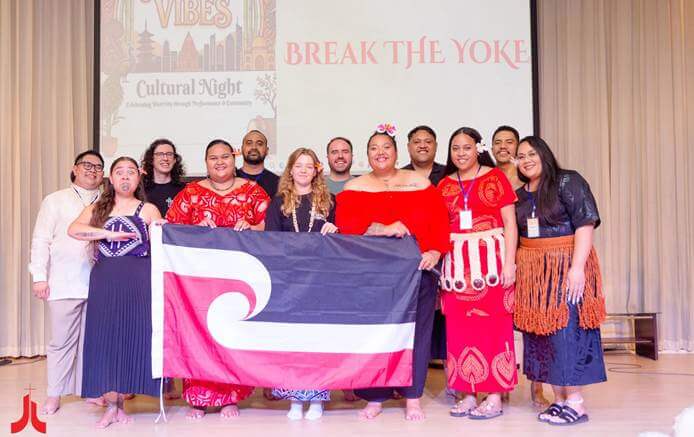
A major highlight of the week was the “Spiritual and Liturgical Expression Night” and “Cultural Night,” where each delegation had the opportunity to share their culture through prayer, song, dance, food, and storytelling. Alongside our whānau from the Methodist Church of New Zealand and the Uniting Church in Australia, we were proud to share waiata, haka, and Pasifika performances that reflected the richness of our cultures and the strength of our relationships across the Pacific. Performing “Tūtira Mai Ngā Iwi” by Rev. Wi Te Tau Huata felt especially significant as a song that speaks of unity and collective strength, while also acknowledging the ANZAC spirit and our shared histories across the Tasman.
Another special part of the journey was the bond formed within our Anglican delegation itself. Although for many of us it was our first time meeting before travelling together, we quickly developed a strong sense of whanaungatanga. Throughout the Assembly we supported one another, reflected together after sessions, practiced waiata together, and carried ourselves as one whānau. It was also encouraging to share the unique story of our three tikanga Church with others throughout the Assembly, many of whom were inspired by our model of partnership and cultural expression within the Anglican Communion.
The experience in Chiang Mai reminded me that the Church is far bigger and more diverse than what we often see at home. It also reminded me that rangatahi across the world are asking similar questions about identity, justice, faith, and the future of the Church. I left the Assembly encouraged by the relationships formed, inspired by the courage and faith of other young leaders, and motivated to continue creating space for rangatahi Māori voices within our Hahi and beyond.
Most importantly, the Assembly reaffirmed that faith is not only something expressed in worship, but something lived out through service, compassion, advocacy, and solidarity with others. The relationships and learnings from AEYA are ones I will carry forward as we continue the collective work of “breaking every yoke” within our own communities and across the wider world.