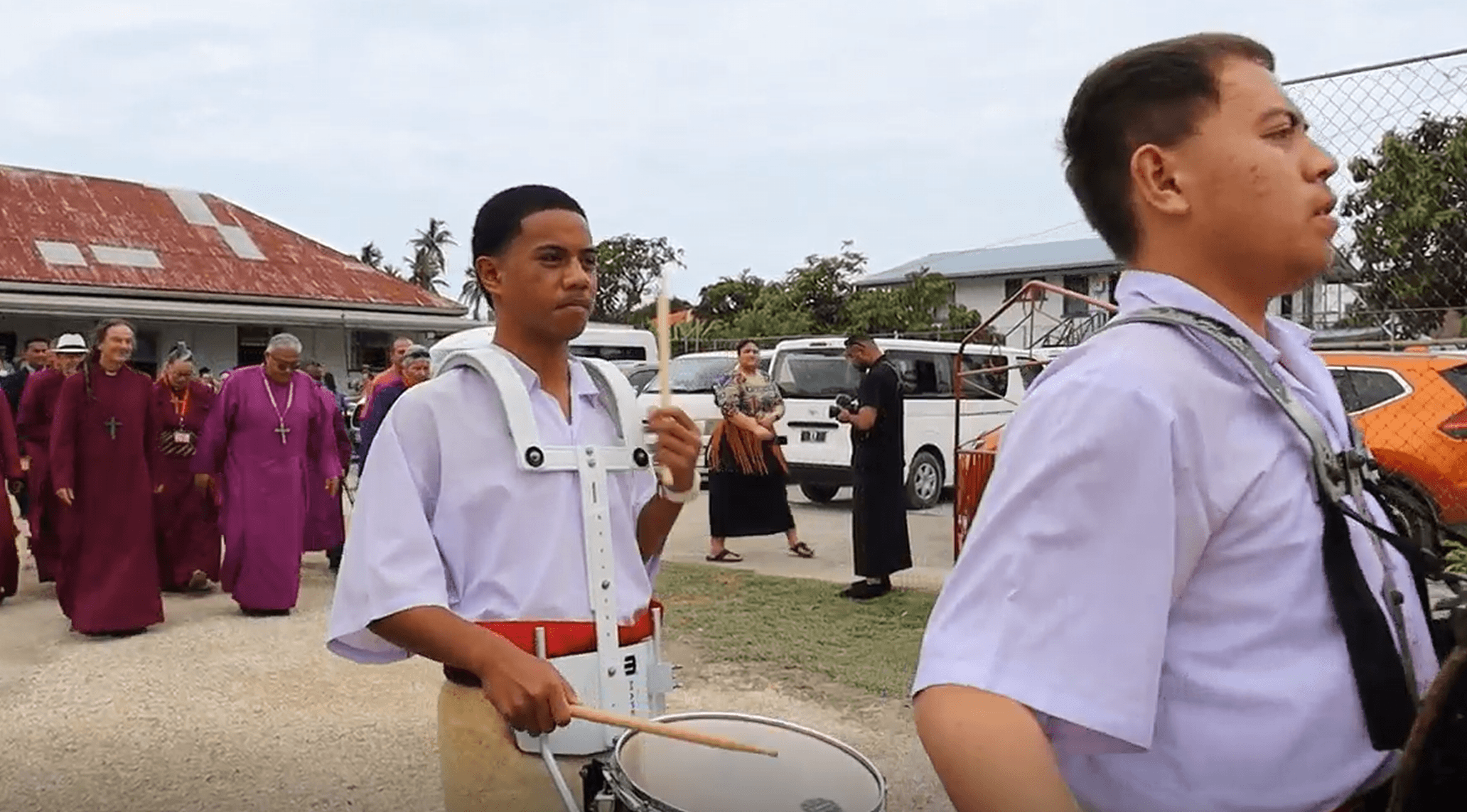
The Anglican Church in Tonga’s long-held aspiration for greater self-governance has entered a significant new chapter following the passing of Motion 15 at the 67th General Synod Te Hīnota Whānui 2026.
Discussions about establishing a Diocese of Tonga began 20 years ago. The Diocesan Synod of Polynesia had already given its approval, pending concurrence from General Synod. Motion 15 sought to fulfil that aspiration.
While acknowledging the efforts and aspirations of the people of Tonga, General Synod encouraged the Diocese of Polynesia to consider structures that would allow all Episcopal Units to pursue their own aspirations and ultimately flourish together.
Fei Tevi, Co Vicar-General of the Diocese of Polynesia, says the latest development affirms the desire within Tongan parishes, while providing clarity about the journey ahead.
“I think the people of Tonga have accepted that there is wisdom in the decision of the General Synod.
“That is the homework we need to do and then get back to the General Synod. We thought that we would be accepted, but there’s also that understanding that we cannot do this without the other Episcopal Units.”
A Vision More Than Twenty Years in the Making
The conversation began in earnest in 2006 when representatives from Tonga approached the Diocesan Synod seeking the creation of a Diocese of Tonga.
Further discussions led to another proposal around 2012, resulting in the establishment of Tonga as an Episcopal Unit, a stepping stone towards possible diocesan status.
The appointment of the late Bishop Afavaka in 2017 marked another important milestone.
“Part of his ministry was to walk alongside the people of Tonga as they prepared to become a diocese. Of course, Covid-19 arrived, and that just delayed a number of things everywhere, including this discussion.”
Around 2022-2023, the idea was broached again. The Tongan leaders looked at it in the context of Te Pouhere and what that requires of any group – churches, vestries, vicarages and parishes – that want to become a diocese.
“In relooking at the constitution, we realised that the Diocese of Polynesia had a unique standing within the constitution itself, which allowed us to determine how we could organise ourselves.”
It was then that Motion 15 to General Synod was developed.
As conversations unfolded at General Synod, Fei says, it became clear that the question was no longer simply whether Tonga should become a diocese, but rather how the Diocese of Polynesia could best reflect its cultural realities and aspirations.
As a result, Tongan church leaders as well as those across Tikanga Pasefika have looked at different models of governance and ministry structures to find what might work best into the future, including partnership models that have developed within and between Tikanga Pākehā and Tikanga Māori in Aotearoa New Zealand.
The goal is not simply to replicate another system, but to find an expression of leadership that is authentically Polynesian, culturally grounded, and responsive to the realities of ministry across the Pacific.
“We cannot do this without the others. If we were to go at it alone, of course Tonga will have its own future, but at what cost?”
Greater Autonomy for Mission
Behind the discussion lies a desire for greater local authority and responsibility.
A future structure could provide Episcopal Units with increased responsibility for matters such as ordinations, confirmations, licensing, and other aspects of church life. Such arrangements would enable ministry decisions to be made closer to the communities they serve while remaining connected to the wider church.
For Tikanga Pasefika, this also provides an opportunity to express its identity more fully. Just as Tikanga Māori has developed structures that express its distinctive character within Te Pouhere, Tevi says the latest development allows parishes and representative nations within the Diocese of Polynesia to adopt their unique characteristics in relationship with each other and the wider province.
“It is very much like the common life projects of the Three Tikanga. We in Tonga have had an opportunity to taste a common life project in hosting General Synod; to see what it means to work together in a three-tikanga church, to listen to one another, understand the dynamics involved, and appreciate opportunities and challenges such a relationship presents.
“So, when we go into discussions about future models within the Diocese of Polynesia, we are really asking: ‘We’ve been a Diocese since the 1960s. We’ve come to know one another better over that time. What comes next? Now that we know each other well, what is the next step?’ That’s the challenge before us.”
As the Diocese embarks on this next stage of discernment, the vision is becoming increasingly clear: a future in which the diverse peoples of Polynesia are empowered to lead, serve, and flourish together in the mission of Christ.