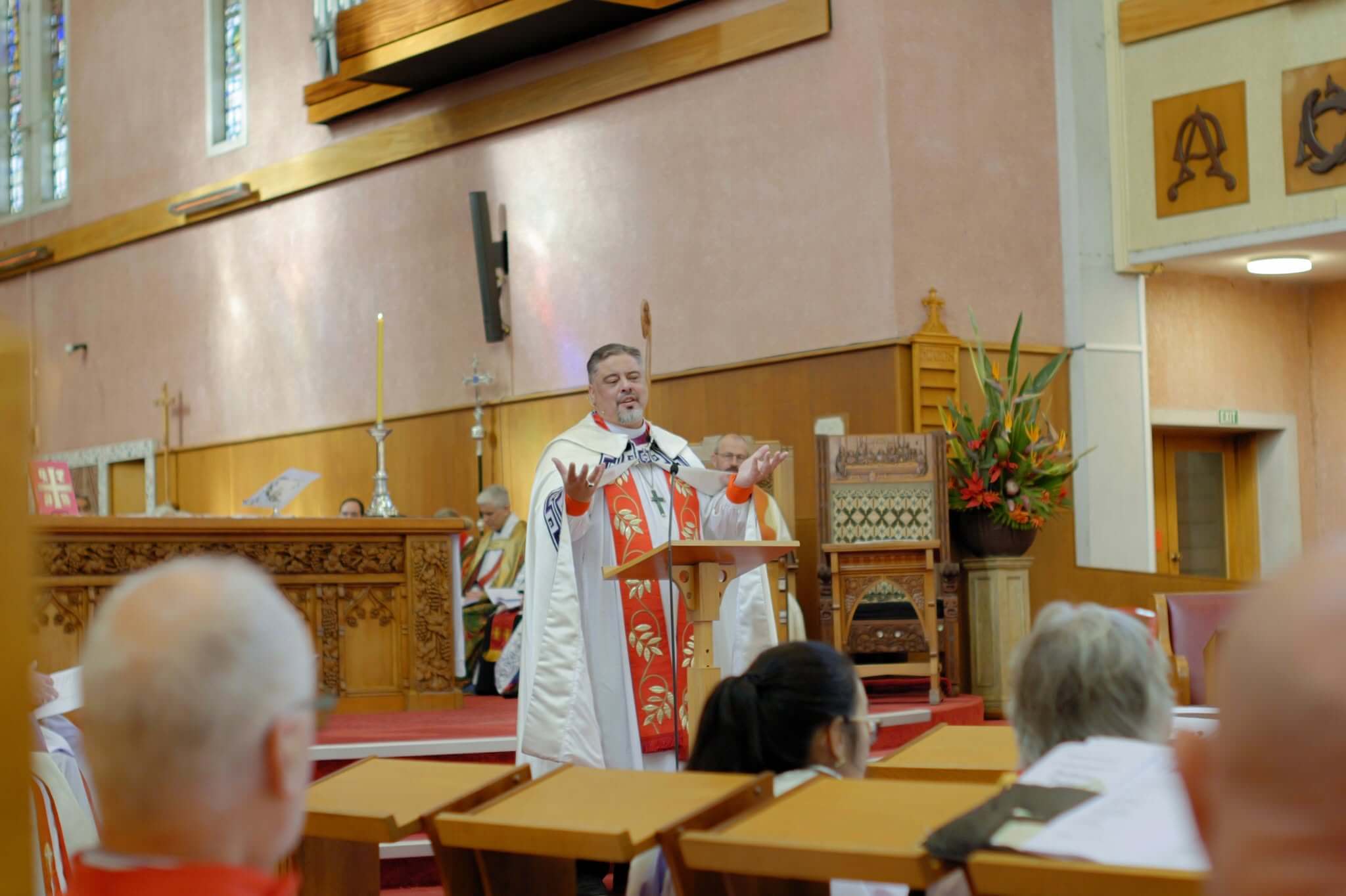
Below is the transcript of the sermon delivered by Archbishop Don Tamihere at the installation of The Very Rev’d Ruihana Paenga as Dean of Waiapu Cathedral, Napier on August 1, 2026.
Ruihana, this is a great day.
There’s so much woven into this day that I’m not sure we’ll comprehend it in this moment.
It might take us a long time to realise what this all means.
There’s a whakapapa to this day.
We can think about the arrival of the gospel in Te Tairāwhiti when Piripi Taumataakura and his other whanaunga were returned to the Waiapu Valley after being missing for more than a decade.
It was said that when Piripi returned, the people felt it was as if he had risen from the dead.
But Piripi had returned with a taonga, a new wānanga, something that he wanted to weave into the wānanga that already existed among our people.
And so it was that as the story is told, he began to preach up and down the Waiapu valley.
And his expertise in unpacking Te Paipera Tapu, the Holy Scriptures that were brought from another land and weaving it into the mātauranga of our people made this wānanga come to life.
And for decades he did that work. He’s referred to by some as an evangelist.
But our people gave him another name.
Ko Rangitukia rā te pariha i tukuna ai ngā kaiwhakaako tokowhā.
Ruka ki Reporua, Hohepa ki Te Paripari, Kaawhia ki Whangakareao, Apakura ki Te Whangapirita e!
And so, our people called them kaiwhakaako.
If ako is a Māori word that means to teach and to learn, and whakaako means to make teaching and learning, then a kaiwhakaako is a maker of teaching and learning.
Piripi Taumataakura was not an evangelist. He was a leader of wānanga.
So, we remember Piripi Taumataakura as the arrival of this gospel message into Te Tairāwhiti.
There’s a little bit of argument about where he preached his first sermon. Our cousins in Te Wharekāhika say it was there and our cousins in Rangitukia say it was there. And there’s these other relations that reckon it was at Whakawhitirā.
I say that it all happened at once, simultaneously.
But there is no argument, e te whānau, about where his last sermon was preached.
It was at Waiomatatini at a whare karakia called Ōhāki St. Luke’s Church on Easter Sunday 1868, where Piripi taught his people his last lesson.
May you live a resurrected life.
You don’t have to die to live a resurrected life. You can choose.
You can choose to live another way.
So, there’s something beautiful about the wānanga that our people created which was a merging of traditions, a merging of peoples.
Part of the storied history of the Diocese of Waiapu which formed around this faith is that it was a working together of two cultures, two peoples.
The missionaries of the Williams whānau who were a certain kind of missionary, who believed in the idea of raising an indigenous church who believed in the idea of honouring the Tino Rangatiratanga and the Mana Motuhake of the people that they lived among.
And in that sharing we saw taonga being produced.
It’s that relationship equally in the north that produced He Whakaputanga – The Declaration of Independence, Te Tiriti o Waitangi, that produced the Māori translation of the Bible, that produced Māori liturgies, tikanga karakia, that produced Māori dictionaries.
We worked together to flourish together.
And that was the promise that our people knew in the beginning.
But that promise was interrupted when the first wave of Pākehā missionaries who joined eventually with the hundreds of Māori Kaiwhakaako that worked up and down this country were followed eventually by the might of the British Empire and a settler colonial system that had different ideas.
Where the first church believed in the idea that an indigenous people should be self-determining and should construct their own faith in their own reality, the settler machine had no tolerance of such a thing.
The settler machine was here to project the power of European monarchy to extract, to exploit, and if the natives got in the way to eliminate.
We know that’s the story. That’s what happened.
And it interrupted the promise of our faith in this part of the world for more than a century.
And in many ways, we still struggle with the remnants of that experience.
But all the while the first planting of the kaiwhakaako and of our ancestors – Pākehā and Māori – in this place remained stubbornly in the ground.
So even here in Waiapu, in this grand Cathedral, one of the symbols that stayed here as a stubborn reminder of the promise eventually was the placing of these two seats.
In the tradition of the Anglican church, a bishop’s seat is known as a cathedra and it’s a representation of the mana and the authority and the responsibility and the obligation that we confer onto that role.
And for a long time – 98 years – the cathedra of the Bishop of Aotearoa has been housed next to the cathedra of the bishop of Waiapu.
So even in all the decades when we forgot that we were meant to be together, working together, weaving together, these symbols remained, hoping that one day we might pay attention, that we were never meant to struggle apart.
We were always meant to flourish together.
And such symbols remain throughout the infrastructure of our people.
We adopt an anti-Christian, anti-European, anti-colonial stance that gets a little bit indiscriminate because at the same time our ancestors carved the joy of their whakapono into the walls of their wharenui and their whare karakia.
They wrote the words of this gospel into their songs and into their mōteatea.
They put it into their kōwhaiwhai so that we might be reminded that there’s a promise.
There’s a promise to which we are called.
The gospel reading this morning turns to another great Kaiwhakaako, Jesus Christ who loved to teach in parables, who loved to teach in metaphor hoping that we too might one day wake up and understand the meaning.
And in the reading this morning he talks about being a gatekeeper for the sheep. And he ends the lesson by saying, “The thief comes only to steal and to kill and to destroy, but I have come that they might have life and life abundantly.”
And there it is, the whole purpose, the whole reason for our faith.
Jesus describes two realities.
There’s a reality within which we can live where every system and every structure, every experience in that place seems to be stealing and killing and destroying.
You and I can talk at length about what it’s like to live in that place, but maybe you and I don’t realize the effect that it has on us.
It puts us into survival mode. It makes us desperate and anxious. It puts us into a poverty mentality where everything feels like scarcity and we’re always desperate and always anxious and we don’t realise it.
And then we begin to be bitter and resentful, and we fill our hearts with hate, and you hear it in our words and see it in our actions. We become wounded and hurt.
A friend of mine has a great reflection on that state, paying attention to what hurt and wounded people do.
Hurt people hurt people. Wounded people project their woundedness onto others.
I’ve often thought that we as Māori people have to think seriously about that because we have spent decades and decades in grievance and learning the language of victimhood and we’ve forgotten what it means to flourish.
While Jesus points out that reality, he points out another one.
If the domain of the thief is stealing and killing and destroying, the domain that I point to, the place that I invite you to, is one of life and life abundantly.
That’s what Piripi Taumataakura and the others who first preached the gospel in Te Tairāwhiti understood.
This was not simply the product of a foreign whakapono.
This was not simply the system and structure that some other foreign tradition had brought here.
There was actually deep within, a taonga that we could take to ourselves, that might remind us to become the best of what we were always meant to be.
A wānanga of aroha, a wānanga of rongo, a wānanga of hari, a rejection of stealing and killing and destroying and a movement towards life and life abundant.
So, Ruihana, today in many ways is an attempt for us to live into that promise.
The Church itself has been the wrong witness for its own gospel.
We’ve created boundaries and walls amongst ourselves.
This church that promotes unity and speaks of love and peace and joy within
itself started saying, “Some of us own things and others don’t.
Some of these things are ours, but they’re not yours.”
We don’t share with one another because we’ve forgotten how to love one another.
But our ancestors understood that this faith was far more beautiful than that.
That’s why your tipuna in the Waiapu valley called this faith, Te Waerea Ataahua – the beautiful faith that clears the way.
That was always the promise. That was always the hope.
And now we have to do the work to make that promise and that hope real.
Jesus points out that there’s two places for us so that we might understand that we have to move.
We can’t stay in the domain of the thief where things are stolen and killed and destroyed.
We have to move into a place that is much more life-giving.
And, so, we dare to imagine a world where our tamariki and our mokopuna will flourish.
We dare to imagine a world where Te Hāhi Mihinare flourishes and becomes a beacon of what it means to be lifegiving.
We dare to imagine a world where we’re not drawn into conversations that are racist and debilitating and diminishing.
But instead, we move towards a space where we as a broader whānau and a community love and respect and honour each other.
And if we dare to imagine that, and if we dare to hope for that, then we have to dare enough to do the work to make that real.
Ruihana, you’ve got a big job ahead of you.
You are a symbol in many ways and symbols are important.
You are a wahine from the Waiapu. You are a descendant of the faith and a descendant of your people. You are a product of whare wānanga. You are the physical embodiment of all the ancestors that went before you.
And you are a servant of this whakapono that our ancestors chose not that we might be enslaved, but that we might be liberated and set free.
And so it is in a world that is desperately in need of love, we have to become the bearers of that gift, and a symbol of what love looks like when you make it real.
This whare karakia matua is a symbol.
But it should not be a symbol of old traditions, relics and artifacts from an irrelevant belief system.
This should become a house that is alive and vibrant and ringing with the activity of wānanga with the expression of love for all people.
This should be a place where the homeless feel free to come. Where the hungry come to be fed, where the lonely come to be surrounded by aroha and manaakitanga, where all people belong and none are excluded.
Our faith calls us to that promise and to that imagination and to that hope and it also calls us to the work.
We have a saying amongst our people in the Waiapu, Ruihana – Waiapu Kōkā Huhua.
Kōkā are the women of our mothers’ and grandmothers’ generations that are close and loving and nurturing and protective – and occasionally very growly if you come from the Waiapu.
This is not about your age, Ruihana, but you are a kōkā from the Waiapu.
One called to nurture and to raise and to protect and to bring life.
That’s what the huhua in Waiapu Kōkā Huhua means.
It’s by your hands that the people will flourish.
In fact, there’s a greater statement.
It can only be by the hands of our kōkā that our people flourish.
And we desperately need more kōkā stepping up into positions of leadership so that they can show us what Oranga Ake looks like when love, peace, and joy are made real.
You’ll be wearing a cope today that bears the symbols of your people.
Te Poutama Piko Maunga
A pattern taken from within the Ngāti Porou Cathedral – St. Mary’s, Tikitiki. Those that worship there will know the poutama behind the altar is the Poutama Piko Maunga.
It’s where the vertical part of the pattern is elongated and that draws us to our connection, our relationship to the divine.
Te Poutama Piko Whenua
And at the other end of the whare karakia is the baptismal font, a memorial of Piripi Taumataakura, and the poutama that is there is the Poutama Piko Whenua where the horizontal part of the design is elongated and that draws us back into our relationship with the people.
And that’s the pattern. Love God, love your neighbour. Love God, love your neighbour.
We get those relationships right and we flourish.
There’s a lot of work to do here, Ruihana. I feel sorry for you in a way.
But know that you are not alone.
You are an opportunity for the rest of us here to make the decision.
We will no longer marinate in our hurt and our woundedness, we will no longer give ourselves to the language of bitterness and resentment, of racism and division, but we will move into a place where we can find life and find it more abundantly.
A place where we express kindness and tenderness and compassion to all people.
A place where we withhold nothing and we give away everything.
And there within lies that final beautiful truth. The more we give, the more we gain.
So may we become a people that give love unreservedly, that bring peace without conditions, that bring joy without restriction, that we might teach each other what it means to have life and life abundantly.
Please turn to your neighbour now and say, “I think you’ve got some work to do.”
Kia ora tātou.