We have always formed people by making. The harder question is whether we can lift that work free of a borrowed frame and make it carry what it needs to carry.
BY MICHAEL TAMIHERE
Part I: The Arrivals
The plane comes in low over the bay a little after midday, and the first thing I see of Tūranganui-a-Kiwa is the light on the water. This is the eastern edge of Aotearoa, the coast that meets the sun first, and even in the flat middle of a winter’s day the sea throws it back hard enough to make you look away.
It is Sunday. Nothing has officially begun, though in another sense it already has. The cohort is still arriving: eleven students from Hoani Tapu, the provincial seminary up in Tāmaki Makaurau; two more from here in Te Tairāwhiti; two Pākehā archdeacons from the diocese of Waiapu; and a colleague of mine, Rev Dr Jekheli Kibami Singh, a theologian from Nagaland. By evening we are enough of a body to be welcomed as one. There is a whakatau, the formal calling-in that turns a roomful of strangers into a people who can sit and eat and work together. There is dinner; and karakia; and then the introductions, each person saying where they stand and what carried them here.
Then the Archbishop gets to his feet and tells us why we have come. Don Tamihere, whose vision set the whole thing in motion, leaves us four words to carry through the week. Whakapapa, because none of this starts with us; we are a late bend in a line running back further than anyone in the room can see. Wānanga, the deep place of learning, where knowledge is held in the body and the chant. Wairua, because what we are about here is spirit before it is anything else. And Te Whānau Rua, the vessels of our making, the household of the intellect and the household of the arts, along with the plain, unsettling observation that formation in our church has fed one household for a century and a half and let the other go hungry.
He gives the why. The how is what the rest of the week is for.
The week has a name, Te Aratoi Manawa. The pathway of art; the pathway of the heart. It is a five-day wānanga in kōwhaiwhai for people in formation for ministry, the first our church has run, convened by Te Rau College and taught by the tohunga toi Wi-Kuki Hewett. The premise is simple even if we never acted on it: a priest can be formed at a paint board as well as at a desk.
I had a hand in the design, so read me accordingly. The premise is not what I’m watching this week—whether the church can receive what te ao Māori never lost is.
Wi-Kuki Hewett speaking to the roopu
Let me clear one thing away, because a certain kind of churchgoer will reach for it without thinking: that a week teaching ordinands to paint is a pleasant diversion from the real formation that happens over systematic theology essays and liturgical rubrics. I do not share the worry. The whare wānanga formed people exactly this way. In the old houses of learning, knowledge was carried in movement and memory; haka and karakia and the working of gardens were all counted as formation because they were. Making people by making things is the oldest pedagogy we have. Underneath it sits the premise that a human being is made in the image of a Maker and is therefore made to make. Paul says it to the Ephesians in a single word: we are God’s poiema, his handiwork, the word from which we get poem, created in Christ Jesus for good works prepared long beforehand. To bring a form up out of raw material is not a holiday from faith. It is a way down into it. He toi whakairo, he toi aroha: from love we create, in creating we love.
One of us, however, has not come to make anything. Vania has come to organise. She works for Te Rau, and her plan for the week is to keep things ticking along—facilitating, taking care of the manuhiri, making sure everyone is fed and housed.
“I did not plan to create,” she told me, her fingers clamped firmly to a clipboard. “My plan was just to do my mahi.” Without quite noticing, she had already spoken a heavy script over herself: I’m not artistic. I can’t do this. I’m terrible at art.
For the first days she is present in body while her heart, by her own account, has not yet arrived. I would not have picked her to give me the week’s clearest word.
Part II: The Shoreline and the Scaffolding
Monday morning we spend in wānanga, working through what Te Aratoi Manawa means and what a theology of creativity might be. Then we go together to the Tairāwhiti Museum to begin the week where the made things are—except the made things are not there. The historic collection, the whakairo and kōwhaiwhai we have crossed the island to learn from, is closed for renovation, the room dark behind the hoardings. It passes with a joke, but it sits oddly in me: we came to be taught by the made things of this coast, and they are behind a wall.
So we go up instead—up Tītīrangi, the hill over the bay—and there Rev Te Haumoana gives the students the whakapapa of Tūranga from the top of it. He starts a long way before Cook, with Paoa and Kiwa, the ancestors whose coming names this place, with the canoe Horouta and its breaking and the long history the breaking sets in motion. Knowledge had been arriving on this coast for centuries, carried by people who crossed Te Moananui-a-Kiwa by stars and swell and the flight of birds, before any of the rest of it.
Rev. Haumoana
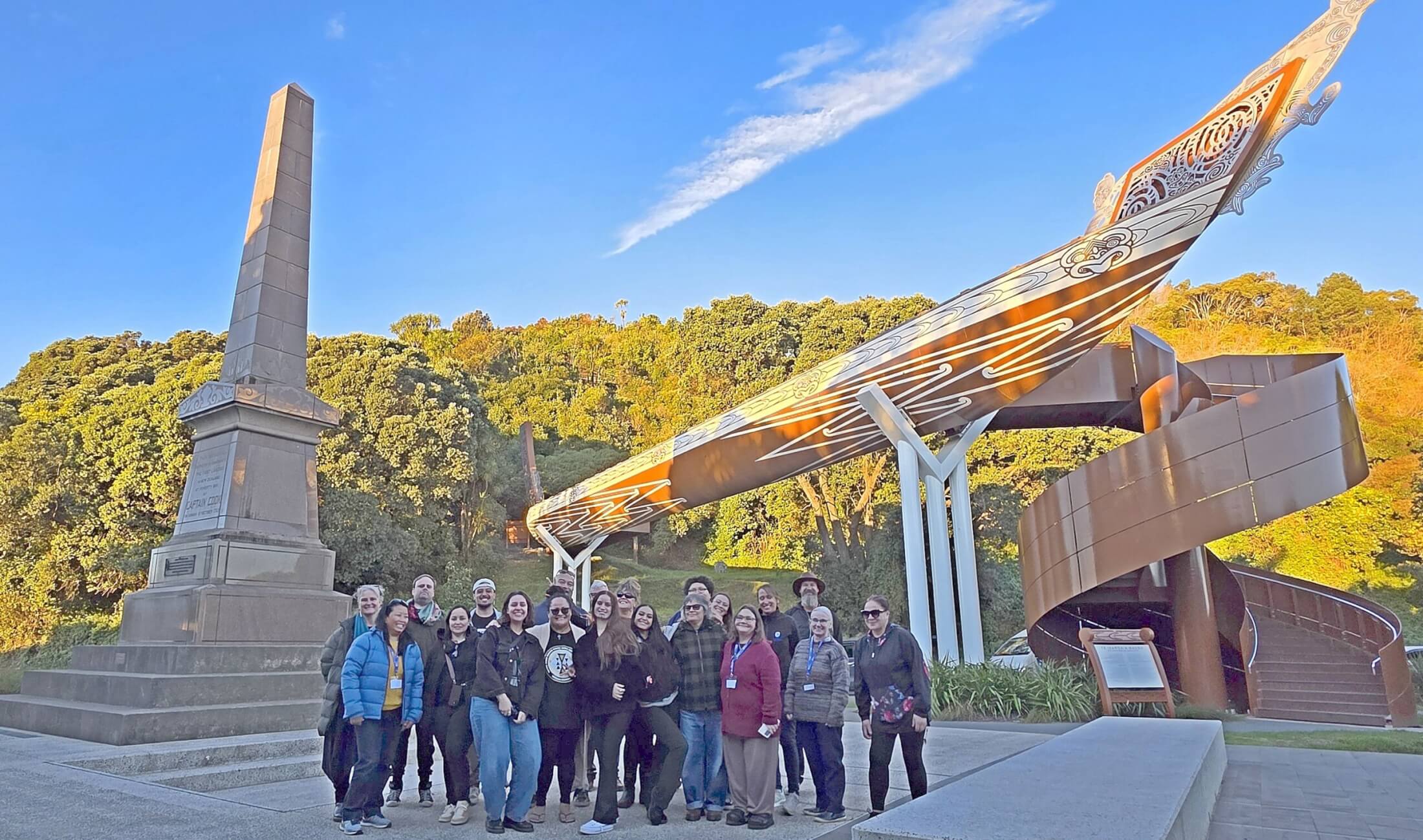
And then, almost a footnote from up here, the Endeavour: Cook coming ashore in the spring of 1769, hoping for friendly contact and finding within a day that the hoping was over. Nine Māori dead before the ship weighed anchor, the first a Ngāti Oneone rangatira named Te Maro, who has his own sculpture now, raised when the country marked two hundred and fifty years since Cook and could no longer pretend the old stone told the whole story.
Down at the river mouth stands that old stone: pale, severe, the first memorial to Cook raised anywhere in the country, set up in 1906, and for most of a century the only account the place set down in durable material. Beside it, newly opened, a bridge. Wai Kahua, with a whakapapa and a name in our own reo. We stand on the new bridge by the old stone, and something settles that will keep returning all week. One answer to a story you cannot like is to make a truer one beside it. The whole shoreline is doing it now, and we have brought more than a dozen people here to learn to make it tangible.
That evening, back at Te Rau College where we are staying marae-style, Vania begins to teach us a pātere—Haramai a Paoa, a chant retracing the arrival of the Horouta waka—that we will sing at each place we go until, by Friday, it lives in the body and not on paper. We get the rhythm of it down, stumbling at first and then less.
In the first of the nightly reflections, the first deep reading of our programme comes not from me but from the cohort. Larissa, who came with the Hoani Tapu vans but is from here, says what she has loved most is being back among the friends she loves from home—and then, almost surprised, that she has realised she actually likes her fellow students from Hoani Tapu too. The room laughs. A woman discovering that the people she travels with have become, somewhere on the road, her people. Belonging and reconnection, the whole theology of the week, surfacing on its own in the mouth of someone describing what was, to her, simply a good day. The practice, it turns out, runs out ahead of our words.
Larissa Ruru (far right)
Part III: The Disagreement in the Wood
Tuesday we drive to Manutūkē, and the church is the first real surprise of the week. From the road it is a colonial chapel—weatherboard, a steeple, the plain Anglican grammar erected in a thousand villages. Then you go in, and the inside has been speaking another language the whole time.
Toko Toru Tapu is one of the very few carved churches in the country, the present building raised in 1913 on the ground of the first churches of the mission William Williams began here in 1839. Māori wearing the church like a coat. And the disagreement that produced it is no metaphor. It happened here, in wood.
When the carvings were first made, the tohunga whakairo was Raharuhi Rukupō of Rongowhakaata, born in Manutūkē, reckoned now among the greatest who ever lived. He carved as his people had always carved: ancestors, atua, the human form. The missionary would not have it; gods and human figures had no place on the walls of a church.
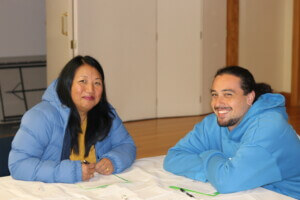
Rev. Jekheli and Sam (akonga)
Nobody surrendered. Instead, the carvers reworked the figures into manaia, the beaked, sidelong form, neither quite person nor quite creature, until Williams, looking at the same wood, saw only pattern and approved it in the mission record as carving that showed “neither man, beast, nor creeping thing.” He did not see that the ancestors were still there, merely turned, the way a word can be folded so it passes one ear and lands whole in another. A whole new school of design came out of that turning; they named it Te Pītau a Manaia.
Next door is the wharenui that carries the carver’s name, Te Poho o Rukupō, and we go in and stand under the kōwhaiwhai while Wi-Kuki helps us identify the fundamental patterns. We sing Haramai a Paoa inside the carved house, and it lands differently than it did the night before. Here is the precedent that authorises everything we are trying to do. Before living memory, in this place, making and faith met and negotiated what could be made, and neither walked away; they made a third thing that held both. Rukupō did it before us, in a far harder room, and succeeded.
And then the harder note, and with it the question turns from words to things. Rukupō’s most celebrated house is not here. Te Hau-ki-Tūranga, the meeting house he raised with others in the early 1840s and one of the finest of its age, was taken from his people in 1867 and held for the better part of a century and a half far to the south in Wellington. Only lately, through a Treaty settlement, has the road home opened: the title returned, the Crown’s apology made.
Even so, the house has not walked it. It stands in the national museum, owned now by its people but still at a physical distance from them.
We stand in the heavy silence of that absence. A house is more than its beauty—it is also the people it shelters, the dead it remembers, the ground it rose from, and lifted out of those it is a house in exile. We can make; whether what we make is then received, or kept, or stolen, is out of the maker’s hands. Making, alone settles nothing.
The old people have an answer to that, and it is the pūrākau of Mataora. He struck his wife, Niwareka, and she fled home from him down into Rarohenga, the world beneath. Ashamed, he followed, his face painted in spirals of soot and ochre and blue clay to make himself fine for the descent. But it is the long way down, and by the time he came before Niwareka’s father, Uetonga, the paint had wept and run, and Uetonga’s people laughed at the mess of him. Uetonga knew those spirals—but as something you did not wear on a face. You wore the cut, the uhi, the tā moko; that was the art for the body, because it endured. The painted spirals belonged on the timber, the rafters, inside the house. You paint the dwelling and you carve the skin; the surface tells you which art it wants. They can take the painted timber. They cannot confiscate the covenant written into the living flesh. Some making is cut so deep it alters the soul, reaching a place where no economy of taking can touch it.
Still the internal mark is consoles more than it remedies. The empty place is the visible edge of a longer economy of taking—taonga, land, and the wealth that follows them—and the same imbalance runs, in the present tense, under one church roof. Our church is constituted in three tikanga meant to walk as equals; the oldest and most unequal partnership, Māori and Pākehā, is the one household kept lean while the other was fed. Here the truer thing that has to be made beside the story is not a painting at all. It is return: the slow, unglamorous work of figuring out what belongs to whom and giving it back. That is what decolonising the faith has to mean. Returning rather than any amount of posturing. The hand makes the truer thing; it cannot, on its own, bring the house home. A church that learns to give back what it took might begin to.
Part IV: The Breaking of the Walls
Back at Holy Trinity Hall after lunch, the week turns from other people’s making to ours. We start on paper with the basic forms—the koru, the koiri, the rauru—and the manawa line first of all: the long curving spine the artists draw before anything else, the backbone from which everything grows and to which everything returns. Get it wrong and nothing built on it will stand. The line runs out from the heart of the panel and home to it again.
Some take to it. Some struggle, and you can watch the struggle cross their faces—the gap between the form held in the mind and the line the hand lays down.
Vania is not at a board. She is moving between them, checking that everyone has what they need, still hiding behind the safety of administrative logistics. She has told herself an old story about her limitations, and for now, she believes it.
Then, somewhere in the afternoon, with music going, Kalah—the youngest of us, nineteen, from Whakatū—begins to sing Haramai a Paoa over the top of the music as she draws, quietly at first and then with her whole voice. One by one the others come in under her. Nobody asks them to. A pātere we could barely stumble through on Monday night is now what the room reaches for without thinking, sung over the scratch of pencils. The knowledge you can sing while your hands are busy is the knowledge you actually have.
The communal voice fills the room, and the sound cracks Vania’s defences. Reluctantly, she finally sits down in front of a blank board.
“For those first couple of days I was basically in the room”, she told me later, laughing at her own stubbornness, “I was running around with my clipboard, totally present in body, but my heart hadn’t arrived at all. I thought the whole challenge was just learning how to handle a paint brush. But I sat down, and this old familiar voice just took over: You’re terrible at this. You can’t do it. It was like a script I couldn’t stop reading. But once I just stopped trying to be perfect, stopped looking over my shoulder at everyone else’s boards… the noise just cleared out. The board didn’t change first. I did. I realised God was doing the actual painting, and He was doing it on me.”
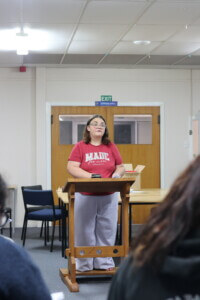
Rev. Heeni, a student from Te Waipounamu
Watching her pencil trace the timber, I realise the danger of the word creativity is the modern freight we load onto it—the romantic inheritance that hears “make” and thinks individual self-expression, the solitary ego finding its unique voice. Whatever is happening at these trestle tables, it is not that.
The others are drawing now, and the shape they make without meaning to is a collective one. Christopher has reconnected with training he walked away from years ago; the night before, he opened one of Wi-Kuki’s books by chance straight to a photograph of his own old tutor. Jayell is using the mangōpare, the hammerhead, because her father had it embroidered on his alb. Jekheli notes that the red, black, and white pigments we are mixing are the exact traditional colours of her own people in Nagaland, half a world away.
Nobody found an isolated, original voice this afternoon; what each of them found was a way back to something they already carried: a tutor, a father, a people’s colours, a former life. Remembering, more than self-expression. The self that picked up the brush was already a crowd.
Vania was looking down at her own emerging lines, and the irony of the timber was not lost on her. For the past few weeks, she had been staring at Genesis 12 on a laptop screen, wrestling with it for her final assignment of an Old Testament paper she was taking. She had treated the scripture as an academic puzzle to be solved for a deadline. Now the homework had caught up with her hands.
“I’d been typing out all this analysis about Abram”, she told me, “how God tells him to pack up everything he knows and just go, without giving him a map or a destination. He just has to trust the next step. And I realised my own ‘Haran’—the safe, comfortable place Abram had to leave behind—wasn’t a piece of geography. It was just this tiny, safe story I’d been telling myself for years about not being creative. The assignment this week wasn’t just to write a paper about a piece of wood. It was God telling me to drop the script that didn’t belong to me anymore. I had to live the exegesis.”
Part V: The Grammar of the Maker
Wednesday the boards come back out and the paint goes on, and the thing we most believe is happening in front of me. What is happening at these boards has a grammar, and it is the oldest there is. Kia rite—let there be—is first a picture in the mind, the imagining of a world other than the one in front of us. Then ā ka oti—and it was done—the plain decision to move the hand toward the thing imagined, knowing it will fall short of the picture; that gap is where every maker lives, and the only way across it is to move. And then he pai—it is good—the affirmation, which we perform for one another: Wi-Kuki stopping at a shoulder, naming aloud the good in a line so that it grows toward the naming as a seedling leans to the sun. It is, line for line, the grammar of Genesis passing down a row of trestle tables in a hall in Tūranga.
Kristina, who works for Te Rau and has begun to learn carving under Wi-Kuki, tells me about a correction he gave her. She had the fundamentals and wanted to leap ahead, and he said, gently, not to takahi—not to trample—the work of those further along; to respect the process, and the people who put their hours in before her. The whole ethic sits in that one correction: the koru unfurls off the manawa; it does not replace it.
At midday we drive to the marina, where the Tairāwhiti waka hourua sits at its mooring, twin-hulled, purposeful, built for crossing distances that ought to be uncrossable. We go aboard, and Eli talks to us. Eli is one of ours, a kaikarakia, and when the Archbishop charged him with leading a waka hourua programme for young leaders, it was clear it could not be led from a book. He had to become a practitioner. So he joined a five-week voyage on the Uto ni Yalo, a Fijian vaka moana, circumnavigating the two great islands of Fiji, with a crew leading Bible study under sail.
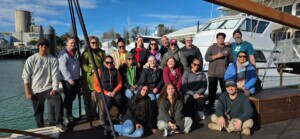
With Eli onboard the waka
He talks about how you find an island you cannot see, with nothing in your hands at all: the stars read as a turning compass carried whole in the body; the deep swells that hold their direction long after the wind that raised them has died, so a navigator can lie in the hull and feel through the timber which way is true. No instrument, no chart—the knowledge lived in the body and the chant, and it planted a people across a third of the surface of the earth.
For a long time, colonial settlers refused to believe it. They decided these islands had been stumbled on by accident, because the alternative—that a people without writing held a science this exact—was a thing they could not let themselves see. The same blindness as the missionary at Manutūkē. In the deep whakapapa, one of the ancestors climbs the spaced heavens and comes back with the baskets of knowledge, not invented on earth but brought from above and planted like seed. One of those baskets holds the arts. The making did not begin with any of us. We are, at the very most, its latest borrowers.
And Eli is the answer, or as much of one as the week is going to give. He did not lift the practice out of the borrowed coat by arguing about words. He got on the boat for five weeks and put the knowledge into his body the only way it goes in, while the rest of us stand on the dock interrogating our vocabulary. Inspired by a canticle I wrote for his journey, he has made a thing of his own, and at the end he reads it—a poem, a prayer: I am the Wayfinder. It is one of the best answers anyone gives all week, and it makes no argument at all, because it doesn’t need to. It is a made thing.
We go back to the boards in the afternoon and many come to completion. And at some point that evening Merekaraka, without being asked, lays the boards out on a table—all of them, side by side, forming the distinct silhouette of a wharenui. The koru off their manawa lines, the reds and blacks and whites, greens and blues and yellows, and the room goes quiet looking at it. A dozen separate afternoons of struggle set down together, and what they make is the face of a house: a dozen separate selves, none of them the house on their own, and none of them dispensable to it. Nobody planned it. Merekaraka just saw that these things were meant to stand together, and set them so.
Vania stands beside me, looking at the collective spine of the timber.
“It was the manawa line that broke it for me”, she told me later. “You look at the line and you realise you can twist and turn all you want, you can doubt yourself or build massive walls to hide behind, but the spine always draws you back to the centre. It’s the breath. It connects me to the room, to the people next to me, to the old people who came before us, and my daughter who comes next. The line doesn’t break just because you get scared.”
Part VI: The Path Laid Down
Thursday we go down the coast to Nuhaka, to the church there, Te Aranga, where Rev Jayell, who is from here, tells its history, and one piece of it stops me where I stand. When Cyclone Gabrielle came down this coast and broke it badly, the footpath to the church was among the small things ruined. It was rebuilt, Jayell tells us, by the men from across the road: the neighbouring Mongrel Mob, who came over and laid the concrete path back down to the door. Another story we cannot like—about who belongs where, who is on which side of a road—and again the answer was a truer thing made beside it: a path, laid by hands the church had reason not to expect, leading to a door. Nobody carved it; it is just concrete. It is also a piece of the gospel: the Kingdom of God arriving exactly where the story said it would not be.
From Nuhaka we backtrack to Mōrere, old forest where the track runs in under nīkau and the light turns green before you reach the pools, and the water rises warm from somewhere deep and unhurried. This is the part of the week I have the least language for, because it is the part that does nothing. Hari—joy—as aroha’s rest: the stillness on the far side of the work, when the love has done its labour and is allowed, at last, to sit down. Rest is not what happens when making runs out; it is the last and hardest thing you make. I notice we had to schedule it, which quietly admits we were not sure it would arrive on its own.
The telling thing is that in the free afternoon the making does not stop. Some sleep. But I find myself leading a student through the making of a porotiti, and next to us Kalah has picked up a chisel and begun to carve one of her painted koru into the wood, moving from the surface that runs to the mark that endures.
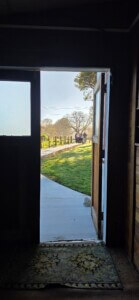
The Nuhaka footpath
That evening those who taught and hosted us arrive, and we have our hākari—hāngī, raw fish, steam pudding, the table loud in exactly the way the first night was quiet. And then the reflections, and I understand this is the part I cannot run, because this is where the architecture has to stand on its own. You can design a space, but you cannot script the spirit that ends up inhabiting it. The verdict belonged to the room.
Alan, who often weeps when he stands to speak and weeps again tonight, shares a poem he began years ago under a spoken-word poet in the Ngatiawa valley and never finished. He finished it this week, he tells us, because Eli’s poem on the waka showed him how. I am a journeyman, it begins. A canticle I wrote moved Eli to write his wayfinder’s poem; Eli’s poem moved Alan to finish his journeyman’s one; and Alan stands and hands it on to the rest of us. Making begetting making, down a chain none of us sees the ends of. I did not teach that. All I did was set the table.
And then Merekaraka, who laid the boards out as a wharenui, says the thing I have been trying to say all week, and says it better, and from inside. “Wānanga like this”, she says, “are easy to love and hard to keep.” The real question is not what happened here; it is what happens when you go back into the ordinary flow of life. “Those of you on the ordination track”, she tells the room, “should be thinking now—tonight—about the team you will need where you are going, and start gathering it.”
The rest of the verdict comes warm and partial and unresolved, which is to say honest. Jekheli speaks of the weight she has carried, the sense of being perhaps the first indigenous Naga person to step into Māori spaces like these, and of what it meant to find her own people’s colours waiting on a board on the far side of the world. Larissa says simply that she has loved coming home. And Jamie, a Pākehā who by his own account would never on his own have walked into a single space we entered this week, asks us, half-laughing and entirely serious, to keep reaching out to weird, awkward Pākehā like him.
Then, because the love has to be allowed to rest, the karaoke comes out, and the same people who sang Haramai a Paoa in a carved house three days ago are now murdering and occasionally transfiguring Springsteen and OutKast and High School Musical—the Naga theologian, the awkward Pākehā, and the nineteen-year-old from Whakatū all taking their turns, Jekheli singing a song in her own language to a room that does not know a word of it and loves it anyway. A kaupapa that can only ever be solemn has not gone into the body. This one had. You could hear it, badly and gloriously, until late.
Part VII: The Scattered Seed
On Friday we have our last breakfast, and pack, and they go. The poroporoaki is short, the way farewells on a marae are always shorter than the welcomes, because the welcome has to turn strangers into a people and the farewell only has to let a people go.
They carry their boards home. The wharenui Merekaraka laid out on the table stood for one evening and then walked out the door in a dozen directions, scattering like the knowledge in the baskets, planted like seed across the whole motu to come up wherever these people come up.
Vania’s panel goes with her. It is an exquisite kōwhaiwhai piece, painted with her daughter Hinemaia in mind—nothing administrative about it now. She chose the vibrant colours of Hinemaia’s beloved kura, Ngā Uri a Māui, so the inheritance flows immediately outward to the next generation. She came to organise and left having made a thing, and the old story about herself stayed behind, no longer hers.
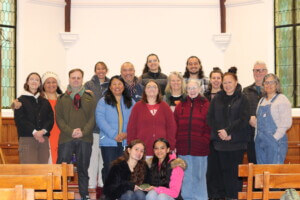
Inside Toko Toru Tapu Church
And here at the end is the one thing I will let myself say about what is to come, because the week has already built it and I only have to read it off the wood. Stand again in the empty place where Te Hau-ki-Tūranga should be, the house given back in law and not yet in fact. That is the exact shape of resurrection hope—not the cheap kind that wipes the grief away but the only kind the gospel offers. Already, and not yet.
Paul says the grain that falls into the ground and is buried is the only grain that bears. The empty place is not that hope failing; it is where the not-yet bites hardest and the hope is most exactly itself. The house owed home, and not home, and the owing is not nothing: a promise with the date left blank.
So I will not give the clean verdict, because there is none, and because Merekaraka already gave the true one, which is a question pointed forward. The makers spent a week making makers; of that much, watching the boards go, I am sure. He toi whakairo, he toi aroha—from love we create, in creating we love, which is in the end the art of handing on the thing you were given.
The vans pull out and turn for the ranges, the boards riding home, the pātere we could not sing on Sunday now lodged somewhere none of them will ever lose it.